Hercules A

Hercules A
Radio-Optical View of the Galaxy Hercules A - Many thanks to: NASA, ESA, S. Baum and C. O'Dea (RIT), R. Perley and W. Cotton (NRAO/AUI/NSF), and the Hubble Heritage Team (STScI/AURA)
Showing posts with label Jovian radiation models. Show all posts

Saturday, September 2, 2017

Examples of Jupiter events observed by Juno Waves

.


--------------------------------
http://agupubs.onlinelibrary.wiley.com/hub/journal/10.1002/(ISSN)1944-8007/issues/
GRL V44 I10   Juno at Jupiter

"Early Results: Juno at Jupiter" a collection of many many Juno papers
http://agupubs.onlinelibrary.wiley.com/hub/issue/10.1002/(ISSN)1944-8007.JUNO1/
--------------------------------
Introductory Radio Astronomy references
http://herrero-radio-astronomy.blogspot.com/2015/06/introductory-radio-astronomy-references.html?m=1
Jupiter events at STEREO A and WIND for correlation with Juno Waves
http://herrero-radio-astronomy.blogspot.com/2017/04/jupiter-events-at-stereo-for.html
Links to Juno related posts
http://herrero-radio-astronomy.blogspot.com/2016/01/links-to-juno-related-posts.html?m=1
Sun Earth Jupiter event posts:
http://herrero-radio-astronomy.blogspot.com/2017/05/sun-earth-jupiter-20170514.html
http://herrero-radio-astronomy.blogspot.com/2015/08/links-to-monthly-sun-earth-jupiter-posts.html?m=1
Solar Cycle 24
https://en.wikipedia.org/wiki/Solar_cycle_24
"The Solar Cycle" by David Hathaway 2015, 81 pages
http://arxiv.org/pdf/1502.07020v1
Driel-Gesztelyi and Green 2015 "Evolution of Active Regions" 98 pages, 11 MB:
http://link.springer.com/content/pdf/10.1007%2Flrsp-2015-1.pdf
Links to recent Solar Radio Science Highlights by Eduard Kontar
http://herrero-radio-astronomy.blogspot.com/2017/02/links-to-recent-solar-radio-science.html
Solar Type Examples
http://herrero-radio-astronomy.blogspot.com/2015/07/solar-type-examples.html
Solar Dynamics Observatory - Now and Daily - Images Movies
http://sdo.gsfc.nasa.gov/data/
NOAA SWPC Solar Event reports with README description of their format
ftp://ftp.swpc.noaa.gov/pub/indices/events/
Preparation for Eclipse 170821
http://herrero-victor.blogspot.com/2016/10/preparation-for-eclipse-170821.html
-----------------------------
..

Sunday, February 26, 2017

Titles of some Juno related papers submitted to Geophysical Research Letters

Selected from :

http://www-pw.physics.uiowa.edu/plasma-wave/juno/publications.html

Direction Finding Measurements of Jovian Broadband and Narrowband Kilometric Radiation From the Juno Waves Instrument Near Perijove 1

Latitudinal Beaming of Jovian Decametric Radio Emissions as Viewed From Juno and the Nançay Decameter Array

A New View of Jupiter's Auroral Radio Spectrum

Generation of the jovian hectometric radiation: first lessons from Juno

Electron butterfly distributions at particular magnetic latitudes observed during Juno’s perijove pass

Io-Jupiter decametric arcs observed by Juno/Waves compared to ExPRES simulations

Plasma waves in Jupiter's high latitude regions: Observations from the Juno spacecraft

Statistical study of latitudinal beaming of Jupiter's decametric radio emissions using Juno

Electron beams and loss cones in the auroral regions of Jupiter


-----------------------
Introductory Radio Astronomy references
http://herrero-radio-astronomy.blogspot.com/2015/06/introductory-radio-astronomy-references.html?m=1
Jupiter events at STEREO A for correlation with Juno Waves
http://herrero-radio-astronomy.blogspot.com/2016/12/jupiter-events-at-stereo-for.html
Links to Juno related posts
http://herrero-radio-astronomy.blogspot.com/2016/01/links-to-juno-related-posts.html?m=1
Sun Earth Jupiter event posts:
http://herrero-radio-astronomy.blogspot.com/2017/02/sun-earth-jupiter-20170223.html
http://herrero-radio-astronomy.blogspot.com/2015/08/links-to-monthly-sun-earth-jupiter-posts.html?m=1
Solar Cycle 24
https://en.wikipedia.org/wiki/Solar_cycle_24
"The Solar Cycle" by David Hathaway 2015, 81 pages
http://arxiv.org/pdf/1502.07020v1
Driel-Gesztelyi and Green 2015 "Evolution of Active Regions" 98 pages, 11 MB:
http://link.springer.com/content/pdf/10.1007%2Flrsp-2015-1.pdf
Links to recent Solar Radio Science Highlights by Eduard Kontar
http://herrero-radio-astronomy.blogspot.com/2017/02/links-to-recent-solar-radio-science.html
Solar Type Examples
http://herrero-radio-astronomy.blogspot.com/2015/07/solar-type-examples.html
Solar Dynamics Observatory - Now and Daily - Images Movies
http://sdo.gsfc.nasa.gov/data/
NOAA SWPC Solar Event reports with README description of their format
ftp://ftp.swpc.noaa.gov/pub/indices/events/
Preparation for Eclipse 170821
http://herrero-victor.blogspot.com/2016/10/preparation-for-eclipse-170821.html
-----------------------------

Thursday, September 1, 2016

" Modeling Jovian hectometric attenuation lanes during the Cassini flyby of Jupiter "

I take note of :

Masafumi Imai , Alain Lecacheux , Michel Moncuquet , Fran Bagenal , Charles A. Higgins , Kazumasa Imai , James R. Thieman,  2015 :

"Modeling Jovian hectometric attenuation lanes during the Cassini flyby of Jupiter"

http://onlinelibrary.wiley.com/doi/10.1002/2014JA020815/abstract

Abstract:

"The Jupiter encounter by the Cassini spacecraft in late 2000 and early 2001 unveiled persistent properties of Jupiter's hectometric (HOM) radiation originating along auroral magnetic field lines in the polar regions. One of the unique properties of the HOM dynamic spectrum, known as attenuation lanes, appears as rotationally modulated, well-defined regions of lowered intensity, flanked by regions of enhancement. These lanes seem to be the result of refraction of radio waves in a high-density medium–either caused by Case (i) enhanced density in the magnetic L-shell connected to Io's orbit or Case (ii) in the Io plasma torus itself or both. In this paper, we investigate the HOM ray paths of 0.5–3.0 MHz emissions with various cone half-angles in the continuous radio longitudes generating at the magnetic L-value equal to 30. We use bi-kappa particle distributions to derive diffusive equilibrium distributions of density in the Io plasma torus. The enhanced density irregularities along the Io flux shell “ribbon” region can be described with a Gaussian density distribution of a maximum density n0 and breadth (half-width of the distribution across the flux shell) sigma. As a result, we found that the interpretation of Case (i) can be accounted for by the attenuation lanes which appear for all cone half-angles, and the reasonable flux shell density n0 is, on top of specific latitude-dependent density from the diffusive equilibrium model, estimated as 100 per cubic cm with the half-width sigma = 5.0 Io radii."

Friday, January 22, 2016

Detection possibilities of "Hot Jupiter" planets orbiting red giant stars, with very large radio telescope arrays

With many thanks, I refer to Fujii at al., 2016:

"Radio Emission from Red-Giant Hot Jupiters"

http://arxiv.org/abs/1601.05428

http://adsabs.harvard.edu/cgi-bin/bib_query?arXiv:1601.05428

Abstract: "When planet-hosting stars evolve off the main sequence and go through the red-giant branch, the stars become orders of magnitudes more luminous and at the same time lose mass at much higher rates than their main-sequence counterparts. Accordingly, planetary companions around them at orbital distances of a few AU, if they exist, will be heated up to the level of canonical hot Jupiters and also subjected to a dense stellar wind. Given that magnetized planets interacting with stellar winds emit radio waves, such "Red-Giant Hot Jupiters" (RGHJs) may also be candidate radio emitters. We estimate the spectral auroral radio intensity of RGHJs based on the empirical relation with the stellar wind as well as a proposed scaling for planetary magnetic fields. RGHJs might be intrinsically as bright as or brighter than canonical hot Jupiters, and about 100 times brighter than equivalent objects around main-sequence stars. We examine the capabilities of low-frequency radio observatories to detect this emission and find that the signal from a RGHJ may be detectable at distances up to a few hundred parsecs with the Square Kilometer Array."

.
 

..
..

Monday, April 21, 2014

"A Passive Probe for Subsurface Oceans and Liquid Water in Jupiter's Icy Moons" using Jupiter's decametric radio emission

With many thanks, I refer to:
   
Romero-Wolf, Andrew; Vance, Steve; Maiwald, Frank; Heggy, Essam; Ries, Paul; Liewer, Kurt, 2014

http://adsabs.harvard.edu/cgi-bin/bib_query?arXiv:1404.1876

Abstract: "We describe an interferometric reflectometer method for passive detection of subsurface oceans and liquid water in Jovian icy moons using Jupiter's decametric radio emission (DAM). The DAM flux density exceeds 3,000 times the galactic background in the neighborhood of the Jovian icy moons, providing a signal that could be used for passive radio sounding. An instrument located between the icy moon and Jupiter could sample the DAM emission along with its echoes reflected in the ice layer of the target moon. Cross-correlating the direct emission with the echoes would provide a measurement of the ice shell thickness along with its dielectric properties. The interferometric reflectometer provides a simple solution to sub-Jovian radio sounding of ice shells that is complementary to ice penetrating radar measurements better suited to measurements in the anti-Jovian hemisphere that shadows Jupiter's strong decametric emission. The passive nature of this technique also serves as risk reduction in case of radar transmitter failure. The interferometric reflectometer could operate with electrically short antennas, thus extending ice depth measurements to lower frequencies, and potentially providing a deeper view into the ice shells of Jovian moons."


Monday, February 17, 2014

Arkhypov, O. V. and Rucker, H. O. 2007, "Effects of magnetohydrodynamic waves in Jovian decametric emission"

I review Arkhypov, O. V. and Rucker, H. O. 2007, "Effects of magnetohydrodynamic waves in Jovian decametric emission"
http://adsabs.harvard.edu/abs/2007A%26A...474.1031A

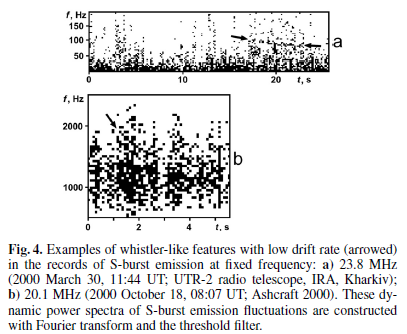
Abstract: "The flux variability of Jovian decametric radio emission (DAM) is analyzed to search for its possible modulations by magnetohydrodynamic waves of ultra-low frequencies (ULF). The ULF modulating waves are found in DAM dynamic spectra as a moving pattern (moire) on the background of Jovian millisecond radio bursts (S-bursts). Their frequency drift ( 55 MHz/s) corresponds to the wave motion to Jupiter with AlfvĂ©n velocity ( 4 × 10⁴ km s-1). There are whistler-like drifting details in the dynamic power spectra of ULF variations of S-burst emission flux at fixed radio frequency. Their frequency drift rates are consistent with whistlers that are dispersed mainly in the Io torus. Formally our analysis of DAM reveals the specific 2s-modulation of S-burst emission corresponding to the known magnetic pulsations near gyrofrequencies of heaviest ions (SO{2}+ and SO+) in the Io torus."


Friday, February 14, 2014

Arkhypov and Rucker 2014, "Dispersion-like phenomena in Jovian decametric S-bursts: Tabooed Facts"

I review Arkhypov and Rucker 2014, "Dispersion-like phenomena in Jovian decametric S-bursts: Tabooed Facts"
http://adsabs.harvard.edu/cgi-bin/bib_query?arXiv:1402.1966

Abstract: "The dominant viewpoint on Jovian decametric S-burst emission neglects the time delay of the radiation, although its base theory of electron cyclotron maser instability allows a significant decreasing of X-mode group velocity near the cutoff frequency at the bottom of source region. We searched for effects of the frequency-related delay of radiation in broadband Jovian radio storms consisting of periodic S-bursts (S-burst trains) at 16 to 30 MHz. It was found that up to 1% of bursts in a train are of distorted meandering shape in dynamic spectrum, where the emission from one radio source was observed at several frequencies simultaneously. It is difficult to explain such spectra in terms of radio waves beaming or causality without significant frequency-related delay of radio emission. We found experimentally that the frequency drift rate of middle lines of such events coincides with the drift rate of disturbances in common S-bursts. This indicates a general distortion of the dynamic spectrum of S-bursts. As a result, the correlation method for the measurement of the spectral distortion is proposed. Using this method, we found the approximation coefficients for the distortion in 32 spectra of 8 Io-B storms. The corrected spectra formally show that S-burst trains do not move mainly outward from Jupiter, as it is usually assumed, but fly in the opposite direction. Our simulation confirms that the dispersion is capable in principle to reproduce the found spectral distortion. Hence, the dispersion-like phenomena in Jovian S-bursts deserve discussion because they have no satisfactory explanations in terms of traditional approach."


Friday, February 7, 2014

Oya et al. 2002, "Analyses Of Jovian Decametric Radiation S-Bursts Interacting With N-Bursts"

I review Oya, Masaru; Oya, Hiroshi; Ono, Takayuki; Iizima, Masahide; 2002, "Analyses Of Jovian Decametric Radiation S-Bursts Interacting With N-Bursts"
http://adsabs.harvard.edu/abs/2002EM%26P...88..187O

Abstract: "Dynamic spectra of S-bursts of Jovian decametric radiations are obtained by using a high time resolution radio spectrograph which has a time resolution of 2 msec and the bandwidth of 2 MHz. Within occurrence of 65 S-burst events observed in the period from 1983 to 1999, 26 events have been identified as the S-N burst events, which are characterized by the interaction between the S-burst emissions and the Narrow band emissions. In the dynamic spectra of the S-N burst, the trend of emissions with negative and slower frequency drift named as “Trailing Edge Emission” are often observed shortly after the appearance of the S-burst. Detailed analyses of these phenomena revealed that the Trailing Edge Emission is not a manifestation of S-burst with slower drift rate but a variation of N-burst. The results suggested that S-burst and the associated Trailing Edge Emission are formed simultaneously started from a common region with different drift rates. It has been further suggested that the appearance of the S-bursts is not controlled by the geometrical effect between the source region and the observer, but directly reflects the generation of the source region widely distributed in an altitude range from a few thousands km to 30,000 km, along the Io flux tube."