Radio-Optical View of the Galaxy Hercules A - Many thanks to: NASA, ESA, S. Baum and C. O'Dea (RIT), R. Perley and W. Cotton (NRAO/AUI/NSF), and the Hubble Heritage Team (STScI/AURA)
Many thanks to the Taxpayers of France, the Nancay Decametric Array Team at the Nancay Radio Astronomy Station of Paris Observatory, and Prof. Dr. Kazumasa Imai, Kochi National College of Technology, Kochi Japan.
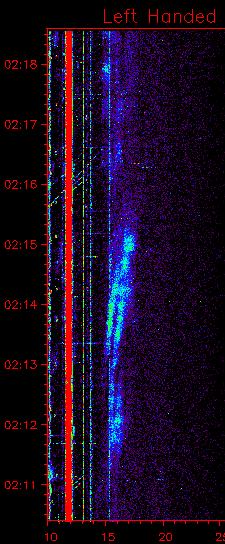
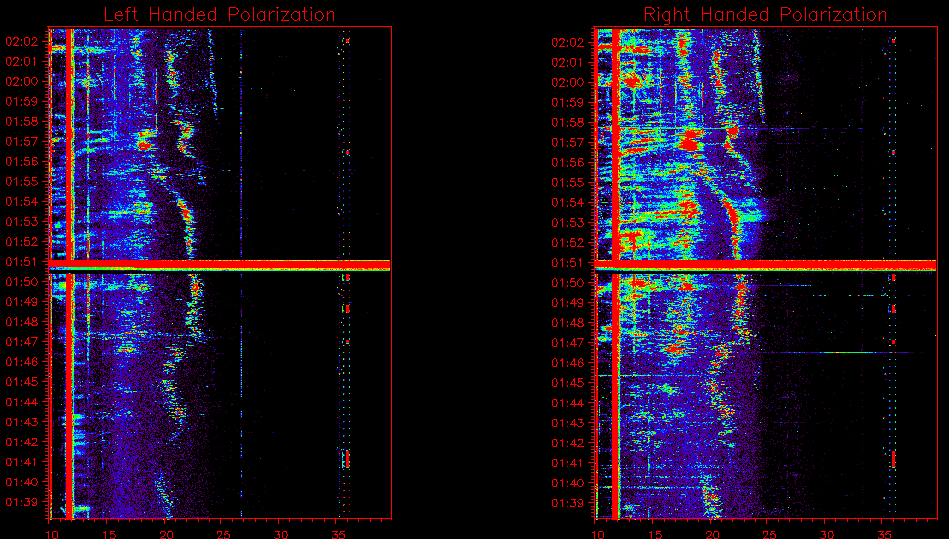
The vertical scale is hours and minutes of Universal Time The horizontal scale is MHz
Abstract: "The dominant viewpoint on Jovian decametric S-burst emission neglects the time delay of the radiation, although its base theory of electron cyclotron maser instability allows a significant decreasing of X-mode group velocity near the cutoff frequency at the bottom of source region. We searched for effects of the frequency-related delay of radiation in broadband Jovian radio storms consisting of periodic S-bursts (S-burst trains) at 16 to 30 MHz. It was found that up to 1% of bursts in a train are of distorted meandering shape in dynamic spectrum, where the emission from one radio source was observed at several frequencies simultaneously. It is difficult to explain such spectra in terms of radio waves beaming or causality without significant frequency-related delay of radio emission. We found experimentally that the frequency drift rate of middle lines of such events coincides with the drift rate of disturbances in common S-bursts. This indicates a general distortion of the dynamic spectrum of S-bursts. As a result, the correlation method for the measurement of the spectral distortion is proposed. Using this method, we found the approximation coefficients for the distortion in 32 spectra of 8 Io-B storms. The corrected spectra formally show that S-burst trains do not move mainly outward from Jupiter, as it is usually assumed, but fly in the opposite direction. Our simulation confirms that the dispersion is capable in principle to reproduce the found spectral distortion. Hence, the dispersion-like phenomena in Jovian S-bursts deserve discussion because they have no satisfactory explanations in terms of traditional approach."
Many thanks to the Taxpayers of France, the Nancay Decametric Array Team at the Nancay Radio Astronomy Station of Paris Observatory, and Prof. Dr. Kazumasa Imai, Kochi National College of Technology, Kochi Japan.
Many thanks to the Taxpayers of France, the Nancay Decametric Array Team at the Nancay Radio Astronomy Station of Paris Observatory, and Prof. Dr. Kazumasa Imai, Kochi National College of Technology, Kochi Japan.
Many thanks to the Taxpayers of France, the Nancay Decametric Array Team at the Nancay Radio Astronomy Station of Paris Observatory, and Prof. Dr. Kazumasa Imai, Kochi National College of Technology, Kochi Japan.
Many thanks to the Taxpayers of France, the Nancay Decametric Array Team at the Nancay Radio Astronomy Station of Paris Observatory, and Prof. Dr. Kazumasa Imai, Kochi National College of Technology, Kochi Japan.
Many thanks to the Taxpayers of France, the Nancay Decametric Array Team at the Nancay Radio Astronomy Station of Paris Observatory, and Prof. Dr. Kazumasa Imai, Kochi National College of Technology, Kochi Japan.